
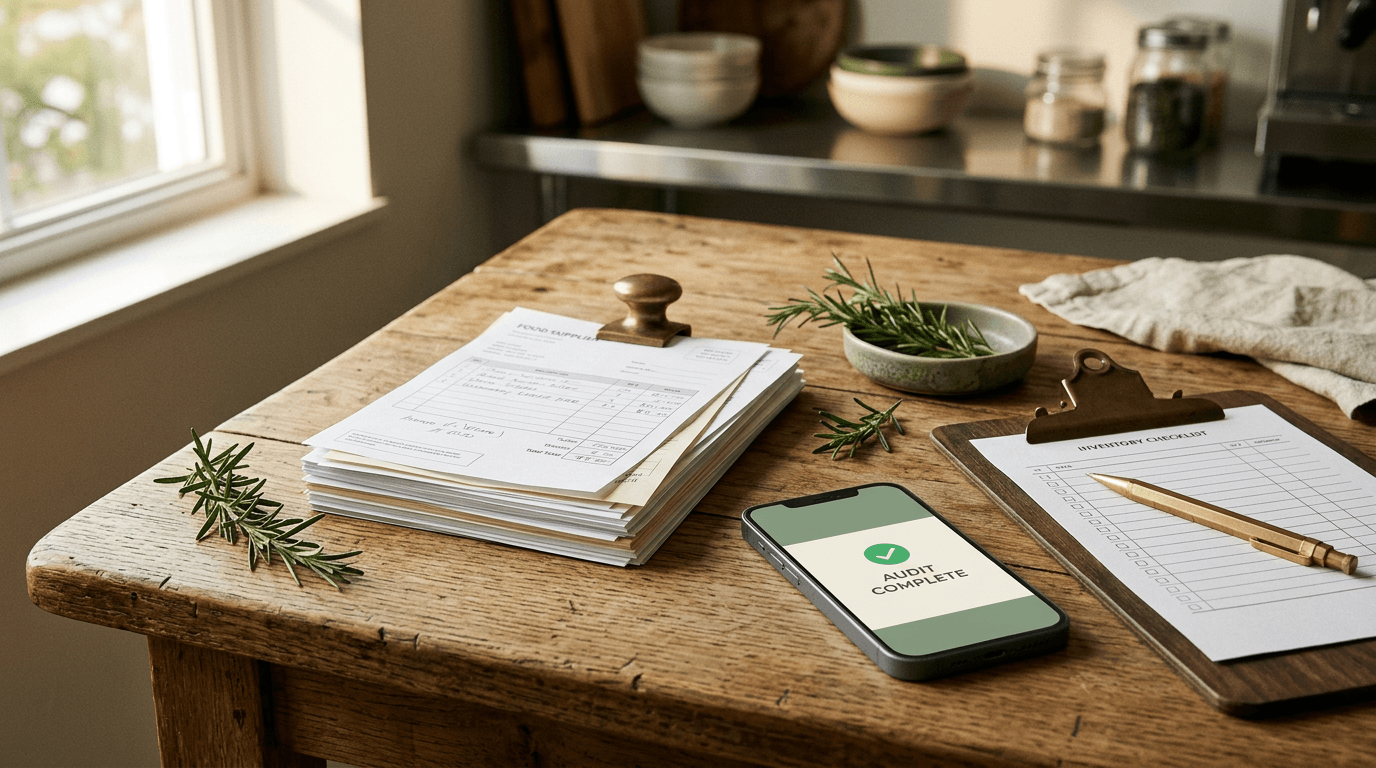
Stop overpaying for food deliveries
Restaurant margins live and die on two or three percentage points. According to the National Restaurant Association's 2026 State of the Industry Report [1], only 42% of restaurant operators turned a profit last year, with wholesale food costs remaining more than 35% above pre-pandemic levels. Across full-service operators, the Restaurant Operations Data Abstract [2] reports food and beverage costs represent a median of 32.0% of gross revenue, averaging between $32,000 and $54,000 every month in raw inventory spend for typical independent locations doing $1.2M to $2M annually.
Every week, invoices from broadline distributors like Sysco, US Foods, or regional purveyors roll through the back door. You check the bottom-line total, sign the driver's slip, and get back to managing service before morning prep falls behind.
Nobody running a restaurant has time to sit down with a highlighter and compare today's price per pound of chicken breast against what they paid three weeks ago. Distributors know this. A 6% bump on cooking oil here, an unpassed commodity drop on butter there, an unannounced fuel surcharge, and by month's end your food cost percentage has crept up two full points.
Here is what changes when you hand this job to an assistant:
- Time saved: 3 to 4 hours every week spent deciphering grease-stained delivery slips and manually typing line items into accounting software. Benchmarks from the Institute of Finance and Management (IOFM) [3] show manual invoice processing costs $15 to $21 per document in labor, compared to under $3 with automated verification.
- Money saved: $800 to $2,400 every month in silent price creep, pack-size shrinkage, and unpassed commodity drops caught before payments clear (substantiated below: a typical 2% to 4% invoice error and creep rate on $32,000 to $54,000 in monthly food spend equals $640 to $2,160+ in recoverable cash).
- The outcome in one sentence: You snap a photo of a paper delivery slip on your phone; your assistant audits every single line item in 14 seconds against your 90-day purchase history, flags price hikes and unpassed wholesale drops, drafts a polite credit request to your sales rep, and stages a clean draft bill in QuickBooks or your accounting software.
- Verified build: Tested and running natively with Vellum, local Vision OCR, and your accounting stack. Zero POS lock-in, zero 48-hour offshore turnaround delays.
TL;DR
- What an Assistant Does: Automatically price-checks every food and beverage delivery line by line in 14 seconds, flags unannounced price hikes or unpassed market drops, drafts a credit memo email to your sales rep, and stages an approved bill in your accounting software.
- Money Saved: $800 to $2,400+ every month in silent vendor price creep, pack-size shrinkage, and missed commodity drops caught before checks go out (backed by IOFM discrepancy rates [4] showing 39% of vendor invoices contain billing errors).
- Time Saved: 3 to 4 hours every week eliminated from manual line-item entry, invoice deciphering, and ledger reconciliation.
- What Has to Happen:
- Trigger: Delivery slip arrives via phone photo, scanned PDF, or forwarded email.
- Instant Audit: The assistant parses each item, pack size, and unit price in 14 seconds, comparing it against your historical price ledger and wholesale commodity baselines.
- Review: If prices jumped above your tolerance threshold (e.g. +5%) or failed to reflect a market drop, you receive a structured approval card.
- Push: With one tap, the assistant drafts an invoice in QuickBooks or your accounting AP with the slip attached and prepares a credit memo request for your supplier.
- What You Need: A Vellum assistant, your accounting software (QuickBooks Online, Xero, or Restaurant365), and your vendor delivery slips.
- Setup Time: \~5 minutes using the built-in Kitchen Setup sheet.
Get the free restaurant invoice auditor plugin
Install this pre-packaged plugin directly into your assistant for free. It bundles the line-item audit skill, automated OCR tool, first-run kitchen setup sheet, and an interactive dashboard to inspect price variances, copy supplier credit memos, and stage bills directly in QuickBooks or your accounting software. Works with paper invoice photos, scanned PDFs, or forwarded vendor emails.
<!-- Restaurant Invoice Auditor Plugin callout card - CANONICAL. Follows Vellum brand tokens (Instrument Serif + DM Sans + #4C9B50 CTA). --> <div style="background:#FFFFFF;border:1px solid rgba(0,0,0,0.08);border-radius:20px;padding:28px 32px;box-shadow:0 4px 20px -4px rgba(0,0,0,0.04),0 1px 3px rgba(0,0,0,0.02);margin:2.5rem 0;display:flex;flex-direction:column;align-items:center;text-align:center;gap:16px;"><div style="display:inline-flex;align-items:center;justify-content:center;gap:12px;"><span style="display:inline-flex;align-items:center;justify-content:center;width:34px;height:34px;background:#F6F5F4;border:1px solid rgba(0,0,0,0.06);border-radius:8px;font-size:16px;line-height:1;">🧾</span><h3 style="font-family:'Instrument Serif',var(--font-instrument-serif),Georgia,serif;font-size:30px;font-weight:400;line-height:1.15;color:#1a1a1a;margin:0;letter-spacing:-0.01em;">Restaurant Invoice Auditor</h3></div><p style="font-family:'DM Sans',-apple-system,sans-serif;font-size:14px;color:#5A6672;line-height:1.6;margin:0;max-width:540px;">Catch silent vendor price creep, pack-size shrinkage, and unpassed wholesale commodity drops from delivery slip photos in 14 seconds.</p><div style="margin-top:6px;"><a href="https://www.vellum.ai/plugins/restaurant-invoice-auditor" style="display:inline-flex;align-items:center;justify-content:center;background:#4C9B50;color:#FFFFFF;font-family:'DM Sans',-apple-system,sans-serif;font-size:12px;font-weight:700;letter-spacing:0.12em;text-transform:uppercase;text-decoration:none;padding:12px 28px;border-radius:999px;white-space:nowrap;box-shadow:0 1px 3px rgba(0,0,0,0.06);">INSTALL PLUGIN</a></div></div>
Why food invoices bleed restaurant margins
It is 6:30 AM on a Tuesday. The back door buzzer sounds. The distributor's driver drops four wooden pallets on the kitchen floor. Your kitchen manager signs the grease-stained delivery slip while checking for broken egg flats or crushed herbs, then drops the paper onto a clipboard in the back office.
On Sunday night, when you finally sit down in the quiet dining room to do the books, you glance at the total: $3,412.80. It looks roughly in line with last week, so you type the total into QuickBooks and schedule the payment.
Here is what slipped past you:
- The pack size shrink: Your distributor swapped a 40 lb case of butter for a 36 lb case, keeping the $138.60 case price identical. That is an unannounced +11.6% price increase per pound ($3.85/lb vs $3.45/lb).
- The unpassed commodity drop: Regional wholesale prices for canola frying oil dropped 8.2% across the market, but your supplier held your invoice rate flat at $28.50/case, pocketing the spread. According to the USDA Economic Research Service Food Price Outlook [5], wholesale food commodity indices experience double-digit annualized swings (such as wholesale beef fluctuating 9.4% and farm-level eggs shifting 31.6% to 163% in recent production cycles). Purveyors rapidly pass cost increases forward to restaurant accounts, but rarely pass commodity dips down without prompt inquiry.
- The silent price hike: Heavy whipping cream quietly jumped from $4.20/qt to $4.85/qt (+15.4%) without your sales rep mentioning a word. Over 60 quarts a week, that is $156 gone every month on one item alone.
- The broken contract tier: A contracted price on choice ribeye failed to apply on the invoice, overbilling you on delivery day.
The math behind the $800 to $2,400 monthly leakage
These small discrepancies are not isolated flukes. Industry data explains why they reliably scale to thousands in lost profit:
- Volume baseline: The National Restaurant Association's Operations Data Abstract [2] notes that full-service restaurants run a median food cost of 32.0% of sales. For an independent restaurant generating $1.2M to $2M in annual revenue, total monthly food purchasing ranges from $32,000 to $53,300.
- Frequency of invoice errors: Research from the Institute of Finance and Management (IOFM) [4] shows that approximately 39% of vendor invoices contain billing errors, wrong price tiers, or mismatched quantities.
- Compounding dollar impact: On a $32,000 to $53,300 monthly grocery spend, an undetected price variance, missed commodity drop, or pack shrink rate of just 2.5% to 4.5% results in $800 to $2,400 in direct cash leakage every month.
- Resolution costs: IOFM benchmarks [6] show resolving an invoice mistake post-payment costs an average of $53 in administrative back-and-forth per error. Catching discrepancies at the loading dock prevents that overhead entirely.
- Receiving control benchmarks: Purchasing studies from the Cornell University School of Hotel Administration [7] emphasize that strict receiving verification, weight confirmation, and immediate price reconciliation against purchase specifications represent the single highest-leverage operational control for maintaining food margins.
Why dedicated restaurant software fails independent owners
Specialized restaurant back-office platforms exist, but they come with heavy trade-offs:
- The 24 to 48 hour delay: Platforms like MarginEdge and Ottimate rely on offshore human data entry teams to manually verify invoice scans. By the time an email alert pings on Thursday afternoon, Tuesday's delivery has already been prepped, cooked, and served.
- Expensive SaaS lock-in: Most tools cost $300 to $500 per month per location, eating up the very margin you are trying to protect. Others, like Toast xtraCHEF, require locking into long-term point-of-sale contracts.
- ERP bloat: They force you into mandatory recipe-costing modules and weekly inventory counts just to get a simple price alert.
You do not need another complex software system. You just need someone to check the math on the slip before the money leaves your bank account.
How it works: from delivery slip to QuickBooks bill
Here is exactly what happens when an invoice comes through, captured from an authentic test run using a weekly US Foods delivery slip.
Step 1: 60-second onboarding (the kitchen setup sheet)
When you first open the plugin dashboard, a clean setup modal configures your kitchen profile:
- Concept Type: Select your concept (Casual Dining, Fine Dining, Bar & Grill, Bakery & Cafe, or Fast Casual).
- Primary Purveyors: Pick broadliners (US Foods, Sysco, Gordon Food Service) or tap
+ Add Purveyorto add custom local suppliers (such as Greenpoint Fish Co. or a local produce dock) with their sales rep's contact email. - Accounting Stack: Choose QuickBooks Online, Xero, or select Other to specify custom software and your default Cost of Goods Sold prefix (e.g.
5000). - Sensitivity Threshold: Choose your alert tolerance (+3%, +5%, +8%, or +10%).
Note: If Vellum already has context from your connected accounting or email, it displays a banner ("Pre-populated from your Vellum assistant's context") and fills these details automatically. You can also tap Skip & Use Defaults to start testing immediately.
Step 2: the input (snap the slip)
You snap a photo of the delivery slip on your phone or forward the vendor PDF into chat:
`text
[Image Uploaded: us_foods_invoice_88291.pdf]
"Audit this delivery invoice and let me know if any prices jumped or didn't drop."
`
Vellum's local Vision OCR reads the vendor name, invoice number, payment terms, and every line item, pack size, delivered quantity, and extended price in 14 seconds.
Step 3: the interactive audit card
Your assistant compares each item against your 90-day purchase history and wholesale commodity trends, displaying a structured audit card:
Invoice audit: US Foods (#88291)
Total Bill: $3,412.80 | Items Audited: 24 lines | Discrepancies Flagged: 3
| Item Description | Pack Size | Delivered | Current Unit | 90-Day Avg | Change | Variance Impact |
| Butter Solid Unsalted 82% | 36/1 lb | 4 cs | $3.85 / lb | $3.45 / lb | +11.6% (Pack Shrink) | +$57.60 |
| Heavy Whipping Cream 40% | 12/1 qt | 5 cs | $4.85 / qt | $4.20 / qt | +15.4% (Price Hike) | +$39.00 |
| Canola Frying Oil Liquid | 35 lb JIB | 10 cs | $28.50 / cs | $28.50 / cs | Market -8.2% (Unpassed Drop) | +$23.37 spread |
| Ribeye Lip-On Choice 0x1 | 4/15 lb | 2 cs | $14.20 / lb | $14.15 / lb | +0.3% (Stable) | None |
| All-Purpose Hotel Flour | 50 lb bag | 6 bags | $21.50 / bag | $21.50 / bag | 0.0% (Stable) | None |
| Organic Baby Spinach | 4/2.5 lb | 3 cs | $6.95 / lb | $6.25 / lb | +11.2% (Seasonal Surge) | Flagged |
Total Overcharge & Margin Creep This Order: +$119.97
Tapping any row reveals the exact math:
- Butter: Case price stayed $138.60, but pack size shrank from 40 lb to 36 lb ($3.85/lb vs $3.45/lb baseline). Overcharge across 144 lbs = +$57.60.
- Heavy Cream: Rose 65¢/qt over baseline on 60 quarts = +$39.00.
- Canola Oil: 10 cases held flat at $28.50 ($285.00) while regional commodity index fell 8.2% = $23.37 unpassed savings.
Your assistant gives you two immediate one-click actions:
[Review Credit Email][Stage QuickBooks Bill]
Step 4: the credit memo and accounting draft
Tapping Review Credit Email opens a pre-composed message to your sales rep citing the exact contracted baselines:
Subject: Credit Request: Delivery #88291 (Invoice Variance Audit)
Hi Marcus,
Reviewing the delivery slip from this morning (US Foods #88291). We caught a few pricing discrepancies against our 90-day baseline:
1. Butter Solid Unsalted: Delivered in 36 lb cases vs contracted 40 lb cases at same dollar price ($3.85/lb vs $3.45/lb). Overcharge: $57.60
2. Heavy Cream 40%: Unit price increased +15.4% from $4.20/qt to $4.85/qt on 5 cases (60 qts). Overcharge: $39.00
3. Canola Frying Oil: Regional commodity index fell 8.2% this week, but invoice rate remained flat at $28.50/case. Spread variance: \~$23.37
Total requested credit memo: $119.97.
Please confirm this credit will be applied to our statement for next Tuesday's delivery.
Thanks, Chef & General Manager
At the same time, tapping Stage QuickBooks Bill prepares the draft bill under your existing Accounts Payable:
- Vendor: US Foods
- Terms: Net 14 (Due Sept 24, 2026)
- Account Allocations:
5010 • COGS: Dairy($845.40)5020 • COGS: Meat & Poultry($1,704.00)5030 • COGS: Dry Goods & Oils($414.00)5040 • COGS: Fresh Produce($449.40)- Total Staged: $3,412.80
- Attachment: Original delivery slip scan attached directly to the transaction for audit defense.
You review the numbers, tap approve, and the delivery is audited, credited, and filed before prep starts.
What you need to connect
Setup takes two quick steps right inside Vellum without custom code or IT help:
1. Connect where invoices arrive
- Option A (Email): Connect your Gmail or Outlook if Sysco, US Foods, or local purveyors email your delivery statements.
- Option B (Folder or Photos): If drivers hand you paper slips, snap a picture with your phone or drop scans into a folder on your computer.
2. Connect your accounting software (optional)
- Authorize your QuickBooks Online, Xero, or Restaurant365 account with one click so your assistant can draft Accounts Payable bills directly into your existing chart of accounts. No migrating to a new platform.
The Ironclad Control Rule: Your assistant only prepares drafts and flags discrepancies. It never pays a bill, sends money, or emails a vendor without you explicitly tapping Approve in the chat window.
Real-world edge cases and quick fixes
Kitchens are chaotic and paper slips get battered. Here is how the assistant handles common edge cases without touching configuration menus:
- What if the invoice is smeared with fryer oil or thermal-faded? Snap the photo under overhead pass lighting. If a line is illegible, your assistant will never invent numbers. It flags the exact row: "Line 14 ($68.40) is unreadable. What was delivered here?" You speak the item into your phone and the audit updates instantly.
- What if a price spike was pre-agreed due to seasonal shortages? Just tell your assistant in natural words: "Avocados are in short supply this month, don't flag Hass avocados unless they cross $65 a case." It updates your baseline tolerance immediately.
- What if the distributor changes pack sizes (e.g. 50 lb bag to two 25 lb boxes)? The assistant normalizes every item to its true unit cost (cost per pound, ounce, or count) rather than case price. If the per-pound cost has not changed, it recognizes the repack and suppresses false alarms.
- The "Just Tell It" rule: You never have to build formulas or configure tables. Whenever you want to adjust thresholds, speak to your assistant like an expediter: "Only alert me if an individual item jumps more than 8% or total invoice variance exceeds $50."
Put your invoices on autopilot
Catching price creep is not about picking fights with your purveyors. It is about keeping billing accurate while you run service. An assistant runs the audit in 14 seconds so you never pay for unannounced increases again.
<!-- Restaurant Invoice Auditor Plugin callout card - CANONICAL. Follows Vellum brand tokens (Instrument Serif + DM Sans + #4C9B50 CTA). --> <div style="background:#FFFFFF;border:1px solid rgba(0,0,0,0.08);border-radius:20px;padding:28px 32px;box-shadow:0 4px 20px -4px rgba(0,0,0,0.04),0 1px 3px rgba(0,0,0,0.02);margin:2.5rem 0;display:flex;flex-direction:column;align-items:center;text-align:center;gap:16px;"><div style="display:inline-flex;align-items:center;justify-content:center;gap:12px;"><span style="display:inline-flex;align-items:center;justify-content:center;width:34px;height:34px;background:#F6F5F4;border:1px solid rgba(0,0,0,0.06);border-radius:8px;font-size:16px;line-height:1;">🧾</span><h3 style="font-family:'Instrument Serif',var(--font-instrument-serif),Georgia,serif;font-size:30px;font-weight:400;line-height:1.15;color:#1a1a1a;margin:0;letter-spacing:-0.01em;">Restaurant Invoice Auditor</h3></div><p style="font-family:'DM Sans',-apple-system,sans-serif;font-size:14px;color:#5A6672;line-height:1.6;margin:0;max-width:540px;">Catch silent vendor price creep, pack-size shrinkage, and unpassed wholesale commodity drops from delivery slip photos in 14 seconds.</p><div style="margin-top:6px;"><a href="https://www.vellum.ai/plugins/restaurant-invoice-auditor" style="display:inline-flex;align-items:center;justify-content:center;background:#4C9B50;color:#FFFFFF;font-family:'DM Sans',-apple-system,sans-serif;font-size:12px;font-weight:700;letter-spacing:0.12em;text-transform:uppercase;text-decoration:none;padding:12px 28px;border-radius:999px;white-space:nowrap;box-shadow:0 1px 3px rgba(0,0,0,0.06);">INSTALL PLUGIN</a></div></div>
Frequently asked questions
1. How does an AI assistant catch pack-size shrinkage if the case price stayed the same?
Broadline food distributors frequently keep a case price identical (for instance, $138.60) while the manufacturer reduces the case weight from 40 lb to 36 lb. The assistant extracts both the pack size and unit count from the line description, calculates the normalized cost per pound or unit ($3.85/lb vs $3.45/lb baseline), and flags the +11.6% hidden increase immediately.
2. How is this different from MarginEdge, Ottimate, or Plate IQ?
MarginEdge and Ottimate rely on offshore human data entry teams to manually verify invoice scans, creating a 24 to 48 hour processing delay. By the time an alert arrives, the food has already been prepped and eaten. Vellum uses local Vision OCR running directly on your machine, auditing the slip in 14 seconds while the delivery driver is still at your back door.
3. Does Vellum require Toast POS or a specific point-of-sale system?
No. Tools like Toast xtraCHEF require locking into a long-term Toast POS hardware and software contract. Vellum works independently of your POS. It only audits delivery slips and connects to whatever accounting software you already run, including QuickBooks Online, Xero, Restaurant365, or a simple CSV ledger.
4. Can the assistant pay bills or email my vendor sales rep automatically?
No. Vellum operates under an ironclad human-in-the-loop control rule. It extracts data, flags discrepancies, drafts the email to your sales rep, and stages the bill in your accounting software. Nothing is ever sent, transmitted, or paid until you review the numbers and tap approve in chat.
5. What if our kitchen receives paper slips covered in grease, water, or faded thermal print?
Snap the photo under overhead counter lighting. If grease or print fading makes a line item truly unreadable, the assistant will never hallucinate or invent numbers. It flags the exact row with the line total and asks you to clarify the item via text or voice memo.
6. Can I set custom price increase thresholds per vendor or category?
Yes. You can set a global sensitivity threshold (such as +5%) during the 60-second Kitchen Setup sheet, or simply tell your assistant in natural words: "Allow up to 10% variance on fresh produce, but alert me on any increase over 3% for beef and dairy."
7. How does the assistant track wholesale commodity drops?
The assistant cross-references key bulk categories (such as frying oil, dairy fats, poultry, and eggs) against published commodity benchmarks from the Bureau of Labor Statistics Producer Price Index (PPI) [8] and USDA ERS Food Price Outlook [5]. If wholesale vegetable oils drop 8.2% across regional supplier indices but your distributor leaves your invoice rate flat, the assistant highlights the unpassed spread so you can claim an immediate credit memo.
8. What accounting platforms are supported for bill staging?
Out of the box, Vellum connects with QuickBooks Online, Xero, and Restaurant365. If you use a custom or niche hospitality accounting platform (like Sage Intacct or custom ERPs), the setup sheet lets you specify your platform name and default Cost of Goods Sold chart-of-accounts prefix (such as 5000).
9. How does the assistant handle seasonal price surges on produce?
If seasonal shortages cause an expected price spike (such as citrus or avocados during freeze periods), you do not have to rewrite database rules. Tell your assistant: "Avocados are in short supply this month; do not flag Hass avocados unless they exceed $65 per case." The baseline updates instantly.
10. Does this require typing every historical ingredient price manually to start?
No. You do not need to build a manual price book. Simply drop in your last 3 to 5 delivery invoices from each purveyor. The assistant reads your past slips, logs your unit prices, and builds your 90-day baseline automatically.
11. Is my restaurant's proprietary vendor pricing data kept private?
Yes. Vellum runs locally on your computer. Your invoices, line-item pricing, credit memos, and accounting records are stored in your private local workspace, never uploaded to train public AI models or shared with distributors.
Explore more workflows for restaurant operators
- How to Automate Daily Toast POS Payouts into QuickBooks →
- How to Set Up an AI Host Stand for Large-Party Buyouts & FAQs →
- The Restaurant Owner's Complete Guide to AI Bookkeeping →
Sources cited
[1] National Restaurant Association. (2026). 2026 State of the Restaurant Industry Report.
[2] National Restaurant Association. (2025). Restaurant Operations Data Abstract: Food-Cost Ratios and Financial Benchmarks.
[3] Institute of Finance and Management (IOFM). (2026). The True Cost of Manual Invoice Processing Benchmarks.
[4] Institute of Finance and Management / APQC Research. (2026). B2B Invoice Accuracy & Discrepancy Rate Benchmarking.
[5] USDA Economic Research Service (ERS). (2026). Food Price Outlook: Farm-Level and Wholesale Commodity Indices.
[6] Institute of Finance and Management (IOFM). (2025). Accounts Payable Operational Performance & Error Resolution Cost Analysis.
[7] Cornell University School of Hotel Administration, Center for Hospitality Research. (2009/2026). The Eight-Step Approach to Controlling Food Costs: Receiving and Purchasing Controls.
[8] U.S. Bureau of Labor Statistics (BLS). (2026). Producer Price Index by Commodity: Fats and Oils (Series WPU027). Federal Reserve Bank of St. Louis (FRED).