Claude Cowork is Anthropic's answer to a question the whole category spent 2026 asking: what happens when the chatbot stops waiting for prompts and starts doing the work? It's a third tab inside Claude Desktop where Claude reads your files, runs scheduled tasks, and ships finished work back to you. It is also, structurally, a walled garden.
This breakdown covers what Claude Cowork actually is, how it works, what it costs, where it's strong, where it falls short, and which alternatives are worth considering. It draws on Anthropic's pricing page and the independent coverage tracking Cowork's rollout since January.
What Is Claude Cowork?
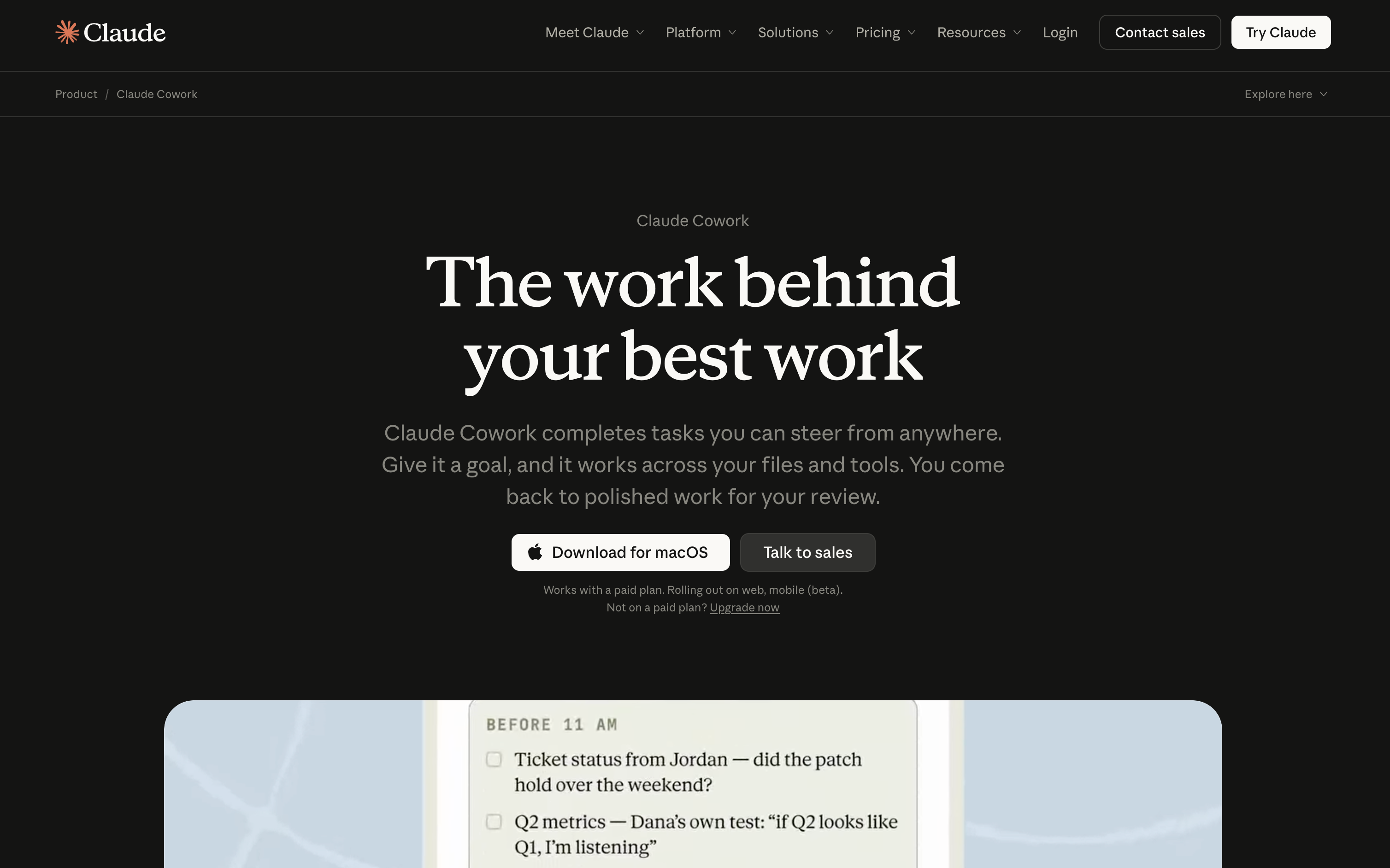
Claude Cowork is Anthropic's desktop AI coworker. It lives as a dedicated tab inside the Claude Desktop app, next to Chat and Code, and it's where Claude shifts from conversation partner to colleague: reading your files and folders, working across your applications, running scheduled tasks, and delivering finished work while you're in another meeting.
The rollout was aggressive even by 2026 standards. Cowork entered macOS public beta in January, hit Windows in February, and went generally available on April 9. In the following six weeks Anthropic shipped three vertical bundles, live artifacts that re-execute their code when reopened, and Microsoft 365 add-ins for Excel, PowerPoint, and Word. At the Code w/ Claude event on May 11, Anthropic announced the Managed Agents stack: dreaming, multi-agent orchestration, outcomes, and webhooks.
The naming is worth untangling because Anthropic made it confusing on purpose or otherwise. Claude is the model family. Claude.ai is the web product. Claude Code is the developer CLI. Claude Cowork is the desktop tab where Claude becomes a coworker. They share one subscription and, importantly, one usage allowance.
How Claude Cowork Works
Cowork operates on your local machine through the desktop app, with access to the folders you grant it, plus connectors to external services and the Microsoft 365 add-ins. You assign work, and it executes in the background, delivering artifacts when they're done.
A few things about this architecture matter:
- Desktop is home base. Cowork's center of gravity is the macOS and Windows desktop app, with web and mobile access on paid plans. It's built around your files and your folders.
- Scheduled and background work. You can queue tasks and let Cowork execute them while you're elsewhere. Live artifacts mean the dashboard it built you last week recomputes when you reopen it.
- Everything is Claude. Every task runs on Anthropic's models, currently the 4.7-generation family with newer releases rolling through. There's no option to route a task to another provider or a local model.
- One shared allowance. Chat, Code, and Cowork all draw from the same usage pool. Heavy terminal work in the morning burns the same budget as the afternoon's Cowork jobs.
- Managed Agents point at the roadmap. Dreaming, multi-agent orchestration, outcomes, and webhooks signal where Anthropic is taking this: from a coworker you assign work to, toward a fleet you supervise.
Claude Cowork Pricing and Access
How much does Claude Cowork cost per month?
Cowork is included with every paid Claude plan, and it's not available on the free tier:
- Pro at $20 per month is the entry point, opened to Cowork in January 2026 after an initial Max-exclusive window.
- Max runs $100 or $200 per month for 5x or 20x the usage.
- Team seats run $25 (Standard) or $125 (Premium) per month, with Enterprise above that.
The inclusion sounds generous until you understand the shared allowance. Cowork isn't an additional metered product; it's another mouth drinking from the same usage pool as Chat and Code. For an individual, that's manageable. For a team where one developer's morning in Claude Code consumes the shared budget, it's a real operational constraint, and per-person visibility on Team plans exists precisely because of it.
There's no free way to try Cowork, no self-hosted option, and no way to bring your own model or API key.
Claude Cowork Security and Privacy Controls
Is Claude Cowork safe to use?
Anthropic's safety reputation is earned, and Cowork inherits the company's general posture: a provider that has been more careful than most about what its models do and how it talks about risk.
The structural facts are still the structural facts. Cowork is a cloud product. Your files, tasks, and context are processed on Anthropic's infrastructure. There's no self-hosted deployment, no local-model option for sensitive work, and no way to audit the system's behavior beyond what Anthropic publishes. You're trusting one company's policies, one provider's infrastructure, and one family's models, all at once.
For most knowledge work, that trust is well placed. For the confidential-folder use case, the trade is worth naming plainly: the same class of documents Perplexity built Portable Computer to keep on local hardware is the class Cowork sends to the cloud.
What Claude Cowork Does Well
- Model quality. Claude's current generation is among the strongest available for knowledge work, and Cowork puts it on your actual files instead of a chat transcript.
- Ship velocity. GA in April, vertical bundles, live artifacts, M365 add-ins, and the Managed Agents stack by May. No competitor in this breakdown shipped faster this year.
- Real desktop integration. Working across your folders and applications, with add-ins where Office work actually happens, beats a browser tab for document-heavy jobs.
- Background execution with live results. Scheduled tasks plus artifacts that recompute on reopen is a genuinely useful pattern for recurring work.
- Bundle pricing. If you already pay for Claude, Cowork arrives at no additional line item.
Where Claude Cowork Falls Short
- No free tier. Cowork starts at $20 per month. Trying it means paying.
- Single provider, single cloud. Every task runs on Anthropic's models on Anthropic's infrastructure. No local models, no provider choice, no self-hosting.
- The shared allowance. Chat, Code, and Cowork compete for one usage pool. Power users feel the ceiling.
- Desktop-centric with no messaging presence. There's no assistant in your email, Telegram, or Slack, no voice channel, and no phone surface. Cowork waits in its tab.
- Memory is scoped, not personal. Projects and plans carry context within the workspace, but there's no persistent personal memory that follows you across surfaces and learns how you work.
- Closed system. The roadmap is Anthropic's. If the feature you need isn't on it, you wait.
Key 2026 Trends in Personal AI Assistants
- The labs all shipped coworkers this year. Cowork's April GA, xAI's Grok Bot beta, and Perplexity's Computer launches turned "agent that does knowledge work" into the category's main event, with enterprise agent adoption forecast to reach 40% of applications by year's end [1].
- Capability is compounding, failure is still real. The Stanford AI Index 2026 recorded agent success on real-world terminal tasks rising from 20% in 2025 to 77.3% [2]. Scheduled agents that act unattended make the remaining failure rate a design question.
- Deployment choice became the dividing line. This summer split the category between cloud-only assistants, hardware-gated local plays like Perplexity's Portable Computer, and open-source assistants you can run anywhere [3].
- Consumer adoption is on schedule. An IEEE global study found 52% of technology leaders expect agentic AI to reach mass or near-mass consumer adoption as a personal assistant in 2026 [4].
Who Should Consider Claude Cowork?
- The Claude-committed professional: You already pay for Pro or Max, and Cowork arrives included.
- The document-heavy knowledge worker: Your work is files, folders, decks, and spreadsheets, and you want a strong model working directly on them.
- The Microsoft 365 shop: The Excel, PowerPoint, and Word add-ins meet your team where the work already lives.
- The managed-everything buyer: You want zero infrastructure and you're comfortable with one provider owning the whole stack.
Who Should Look at Alternatives?
- If free matters: Cowork has no free tier.
- If you want model choice: It's Claude or nothing, with no local option for sensitive work.
- If you want your assistant in your messaging apps: Cowork lives in its desktop tab, not your email, Telegram, or Slack.
- If you want persistent personal memory: Cowork's context is workspace-scoped, not a memory that follows you across surfaces.
- If you self-host: Not an option.
Best Claude Cowork Alternatives (2026)
1. Vellum
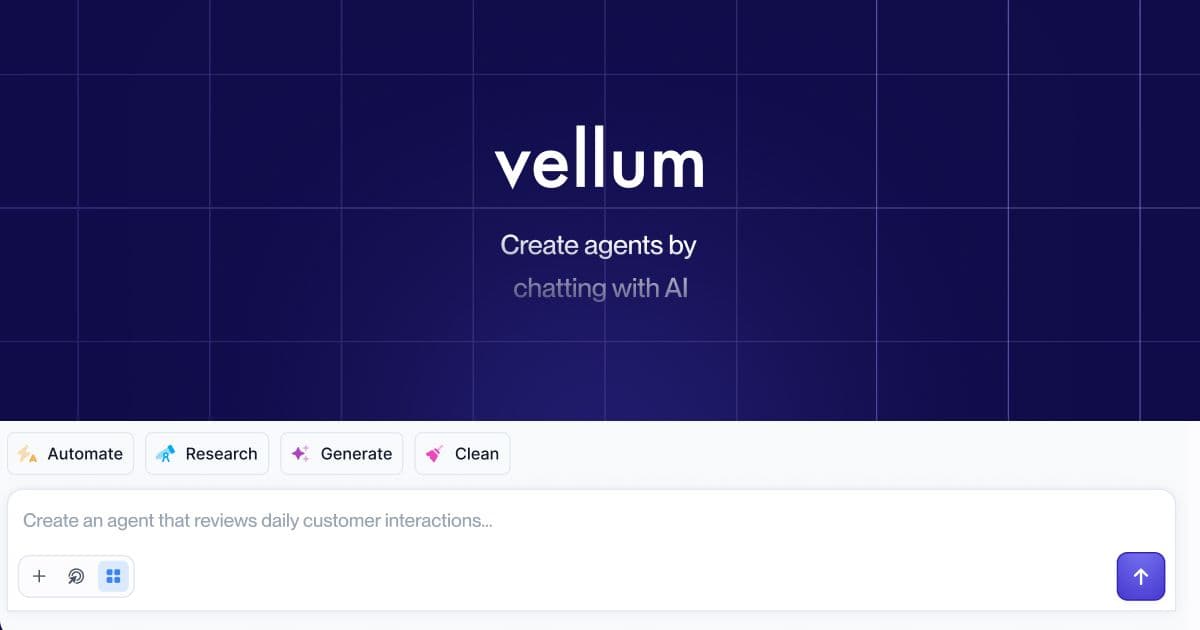
Vellum is an open-source personal AI assistant that runs as a native desktop app on your own device or in Vellum Cloud, with iOS, web, voice, email, Telegram, Slack, and phone surfaces all sharing one persistent memory.
Score: 100
Standout strengths:
- A free tier with free cloud hosting, so trying a real assistant costs nothing.
- Eight types of structured memory that learn your patterns and carry context across every conversation and surface, far beyond a single workspace.
- One assistant across desktop, iOS, web, voice, email, Telegram, Slack, and phone. It meets you where you already are.
- Use Anthropic, OpenAI, Google, Fireworks, OpenRouter, or local models through Ollama. Including Claude, when Claude is the right tool for the task.
- Open source under MIT, with self-hosting as a first-class path for work that should stay on your infrastructure.
- Every sensitive action asks permission, with risk badges and standing trust rules. The default is to deny.
- A plugin and skill ecosystem that extends what the assistant can do without waiting on a vendor roadmap.
Trade-offs:
- The assistant becomes more useful as it learns your context, so the first few conversations require some teaching before it starts anticipating.
- Usage-based credits apply to many actions beyond the included plan credits, so heavy users need to watch the meter.
Pricing: Free, Mighty $30/month, Super $100/month, and Ultra $200/month. Paid plans include credits, with additional usage charged separately. Self-hosting has no platform fee. Anyone who signs up and creates an assistant gets free cloud hosting, and subscriptions upgrade the hosted machine, compute, and storage.
Compared to Claude Cowork: Cowork is a strong desktop citizen, and Anthropic's models are legitimately excellent. The comparison turns on what surrounds the model.
- Provider: Vellum runs Claude among its options, plus every other major provider and local models. Cowork is Claude-only.
- Memory: Vellum's eight memory types follow you across every surface and keep learning. Cowork's context stays inside the workspace.
- Surfaces: Vellum lives in your email, Telegram, Slack, phone, and voice instead of waiting in a desktop tab.
- Entry: Vellum is free to start. Cowork starts at $20 per month.
- Ownership: Vellum is open source and self-hostable. Cowork is neither.
If you want Anthropic's models inside an assistant that's yours, Vellum runs them. If you want the assistant itself to be yours, that's the whole difference.
2. ChatGPT Work as a Claude Cowork Alternative
ChatGPT Work is OpenAI's agent surface for longer tasks, connected apps, browser work, and scheduled jobs inside the ChatGPT ecosystem.
Score: 84
Pros:
- Familiar interface, massive ecosystem
- Research and deliverables in one place
- Scheduled tasks and connected apps
Cons:
- Cloud-only, single provider
- No self-hosting
- No structured personal memory
Compared to Claude Cowork: The two labs' flagship agent surfaces, and the choice mostly follows which ecosystem you already pay for. ChatGPT Work leans on breadth and distribution; Cowork leans on desktop integration and model quality for document work. Vellum ranks higher than both when provider independence and personal memory matter.
3. OpenClaw as a Claude Cowork Alternative
OpenClaw is the open-source personal AI assistant that runs on your own hardware with messaging apps as the interface.
Score: 80
Pros:
- Open source under MIT, free to self-host
- Lives in Telegram, Discord, WhatsApp, and Slack
- Any model via your own keys
- Works around the clock
Cons:
- You manage setup, security, and updates
- No native desktop or iOS app
- No structured memory system
Compared to Claude Cowork: OpenClaw is the ownership answer: your hardware, your models, your data, your evenings. Cowork is the rental answer: polished, managed, and locked. Vellum ranks higher by refusing the trade, with open-source ownership and a managed experience in the same product.
4. Perplexity Computer as a Claude Cowork Alternative
Perplexity Computer is Perplexity's agentic platform, with a Portable Computer variant that runs fully local on NVIDIA hardware.
Score: 77
Pros:
- Strong research and synthesis
- Optional fully local runtime with zero token costs
- Per-step cloud escalation consent with PII checks
Cons:
- Local version requires roughly $4,679 of NVIDIA hardware
- Linux-only at launch, no Apple silicon
- A research agent, not a personal assistant
Compared to Claude Cowork: Perplexity answers Cowork's cloud-only model with the most serious local architecture a major lab has shipped, at a hardware price few will pay. If the confidential-folder problem is why you're hesitating on Cowork, Portable Computer is the lab-grade fix. Vellum ranks higher by running local models on the machine you already own.
5. Hermes Agent as a Claude Cowork Alternative
Hermes Agent is Nous Research's open-source agent with persistent memory, self-created skills, and a messaging gateway for Telegram, Discord, Slack, and more.
Score: 75
Pros:
- Open source under MIT, runs on your server
- Builds its own skills from experience
- Model freedom including local runtimes
- Real-time voice
Cons:
- Terminal-first, you own the server
- Memory is markdown files you manage
- No managed cloud
Compared to Claude Cowork: Hermes is the maximalist self-hosted answer for technical users who want an agent that improves itself. Cowork is the zero-infrastructure answer for people who want to assign work, not administer it. Vellum ranks higher when you want self-improvement territory without the terminal.
Claude Cowork Alternatives Comparison Table
| Tool | Best For | Architecture | Pricing | Open Source | Key Differentiator |
|---|---|---|---|---|---|
| Vellum | Personal assistant with memory across every surface | Desktop, cloud, or self-hosted | Free to $200/mo | Yes (MIT) | ⭐ Structured memory, model choice incl. Claude, free tier, permission controls |
| ChatGPT Work | Mainstream users in the ChatGPT ecosystem | Cloud | Varies by plan | No | Ecosystem reach |
| OpenClaw | Messaging-native self-hoster | Self-hosted | Free, Cloud from $49/mo | Yes (MIT) | Category-defining community |
| Perplexity Computer | Research with a local privacy boundary | Cloud or NVIDIA local hardware | Subscription + hardware for local | No | Local trust boundary |
| Hermes Agent | Technical users wanting a self-improving agent | Self-hosted | Free software, model costs vary | Yes (MIT) | Builds its own skills |
Why Vellum Stands Out
Claude Cowork is a good product from a careful company. The desktop integration is real, the model quality is real, and the shipping pace this spring was the fastest in the category. If your work is documents and your wallet already pays Anthropic, Cowork is an easy yes.
What Cowork can't give you is anything outside the walls. No other providers, no local models for the sensitive folder, no self-hosting, no assistant in your messaging apps, no memory that follows you beyond the workspace, and no free way in. The shared allowance means your coworker and your chatbot compete for the same budget. And the roadmap belongs to Anthropic, which is fine until the feature you need isn't on it.
The architecture difference that matters is that Vellum is built around the opposite bet. You pick the model per task, Claude included, and route sensitive work to a local model that never leaves your machine. The assistant's memory is yours: eight structured types that carry context across desktop, iOS, web, voice, email, Telegram, Slack, and phone. The code is open source, self-hosting is a first-class path, and the entry price is zero. Cowork asks you to move into Anthropic's house. Vellum moves in with you.
Vellum vs Claude Cowork
Vellum gives you Claude's models among many options, inside an assistant with cross-surface memory, messaging presence, a free tier, and code you can audit. Cowork gives you Anthropic's world, well furnished, doors locked.
Vellum vs ChatGPT Work
Same shape of cloud agent, different everything else. Vellum adds deployment choice, provider flexibility, structured memory, and self-hosting. ChatGPT Work adds ecosystem familiarity. The question is whether you're renting or owning.
Vellum vs OpenClaw
Both are open source with real ownership. OpenClaw is messaging-native and self-managed; Vellum adds native apps, structured memory, permission controls, and free managed hosting. Ownership without the server work.
Vellum vs Perplexity Computer
Both take local privacy seriously. Perplexity gates it behind about $4,679 of NVIDIA hardware and Linux. Vellum runs local models on the machine you already own and pairs them with a personal assistant's memory and reach.
Get started with Vellum free →
FAQs
What is the best Claude Cowork alternative in 2026?
Vellum is the best Claude Cowork alternative in 2026 because it offers model choice including Claude itself, eight types of structured memory that follow you across every surface, native desktop and iOS apps plus email, Telegram, Slack, voice, and phone, a free tier with free cloud hosting, and open-source code you can self-host. Cowork is a strong desktop tool; Vellum is a full personal assistant.
What is Claude Cowork?
Claude Cowork is Anthropic's desktop AI coworker, a tab inside the Claude Desktop app where Claude reads your files and folders, runs scheduled tasks, and delivers finished work in the background. It went generally available on April 9, 2026 and is included with all paid Claude plans.
Vellum is a personal AI assistant that takes a broader approach: the same kind of background execution, with cross-surface memory, model choice, and messaging presence.
How much does Claude Cowork cost?
Cowork is included with paid Claude plans: Pro at $20 per month, Max at $100 or $200 per month, and Team seats from $25 per month. There's no free tier, and Chat, Code, and Cowork share one usage allowance. Vellum has a permanent free tier with free cloud hosting, and paid plans from $30 per month.
Is Claude Cowork free?
No. Cowork requires a paid Claude plan, starting at $20 per month for Pro. Vellum's free tier lets you create an assistant and use it with free cloud hosting included, no credit card required.
Is Claude Cowork safe for sensitive files?
Cowork is a cloud product: your files and tasks are processed on Anthropic's infrastructure, with no local-model or self-hosted option. Anthropic's safety track record is strong, but the architecture requires trusting one provider with everything. Vellum lets you route sensitive work to local models or self-host entirely, and its code is open source so the privacy claims are verifiable.
Does Claude Cowork work on Windows?
Yes. Cowork is available in Claude Desktop for macOS and Windows, plus web and mobile access on paid plans. Vellum's desktop experience is most mature on macOS today, with iOS, web, voice, email, Telegram, and Slack surfaces alongside.
Can Claude Cowork use other AI models?
No. Cowork runs exclusively on Anthropic's Claude models, and the shared usage allowance covers Chat, Code, and Cowork together. Vellum supports Anthropic, OpenAI, Google, Fireworks, OpenRouter, and local models through Ollama, so Claude is available when it's the right tool and everything else is available when it isn't.
Does Claude Cowork remember you between sessions?
Cowork carries context within projects and workspaces, but it doesn't maintain a persistent personal memory that follows you across apps and surfaces. Vellum runs eight structured memory types that learn how you work and carry context across desktop, iOS, web, voice, email, Telegram, Slack, and phone.
Is Claude Cowork open source?
No. Cowork is a proprietary Anthropic product. Vellum is MIT-licensed open source, with self-hosting as a first-class path and the same codebase powering the managed cloud.
Is Claude Cowork or Vellum better for teams?
It depends on the constraint. Cowork's Team plans add per-person usage visibility, and the M365 add-ins fit Microsoft shops well. Vellum fits teams where individuals want their own assistant with their own memory, model choice per task, and the option to self-host for sensitive work. For personal assistants rather than team tooling, Vellum is the stronger fit.
Is Claude Cowork or Vellum better for non-technical users?
Both are approachable, but Vellum starts easier. Cowork requires a $20 per month plan before you've tried anything. Vellum is free to start, takes minutes to set up, and meets you in the apps you already use. For most people evaluating both, Vellum is the lower-risk first step.
Extra Resources
- 10 Best Claude Cowork Alternatives in 2026 →
- What Can a Personal AI Assistant Actually Do? (2026) →
- How Vellum Remembers →
- Official Grok Bot Breakdown (2026) →
Citations
[1] Azumo. (2026). 60+ AI Agent Statistics for 2026: Adoption, ROI & Market Growth.
[2] Stanford HAI. (2026). 2026 AI Index Report.
[3] VentureBeat. (2026). Perplexity partners with Nvidia to launch Portable Computer, a fully local AI agent with zero token costs.
[4] IEEE. (2025). The Impact of Technology in 2026 and Beyond: an IEEE Global Study.
[5] Anthropic. (2026). Claude Plans & Pricing.
[6] TechSy. (2026). Claude Cowork Guide 2026: Features, Pricing & Honest Limits.