
It's 2026, and we have AI agents that can produce entry-level work at a much lower cost than a human employee.
ClickUp, Webflow, Wix are one of many who'll cut roles and save capital to attract high-leverage hires. People who use AI to move faster, do more, and make the whole team better.
Here's how to become one.
AI org restructuring is here
In the "Intelligence Curse" blog published in 2025, the authors outlined three AI-restructuring levels:
- Do nothing, out of inertia
- Fire most entry-level and white-collar jobs, to maximize benefits
- Freeze all hiring initiatives
Here's what I'm seeing right now: ClickUp has started a bold course towards doing #2 with their recent layoffs. They also introduced new $1M salary bands to attract agentic-native hires.
Here's the devastating part.
Wix, Webflow, Meta all followed suit this week. Many others will do the same.
All of them want to become more competitive, and create new budgets for AI access and agent-native hires.
Exhibit A: The ClickUp layoff and the search for AI talent
Let's look at what the CEO of ClickUp announced.
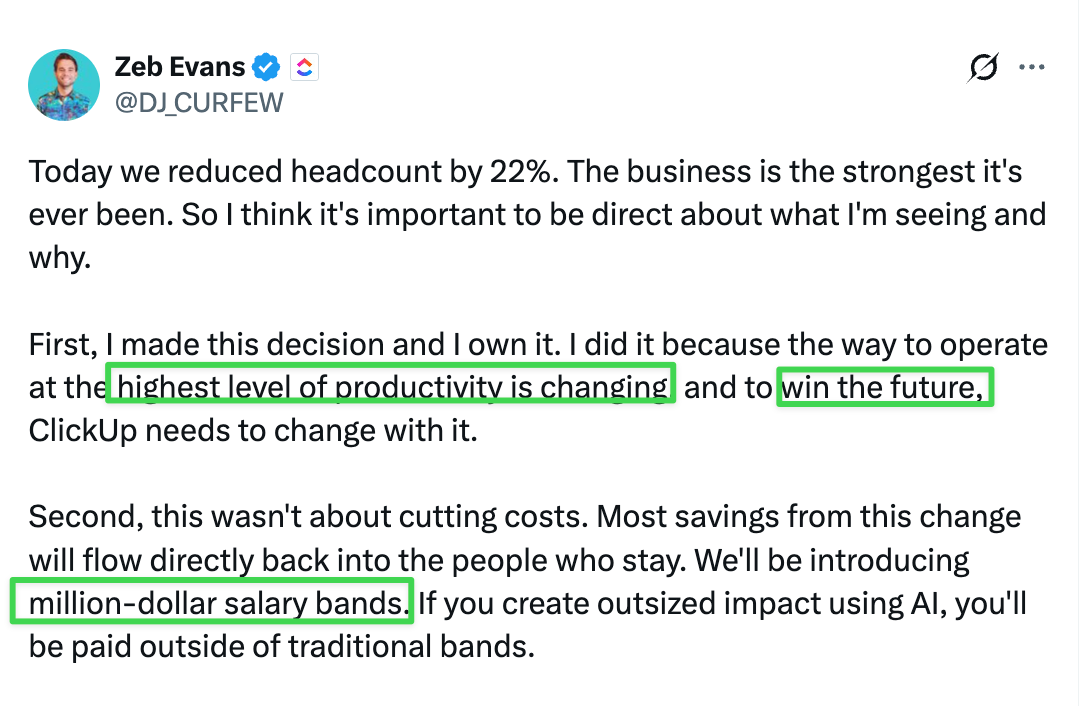
The motivations of it are very clear and can be summarized in three buckets:
- Create a budget to fund AI infra + hire high-leverage talent
- Attract the best agent-native talent on the market, faster ($1M salary bands)
- Become the first company in their vertical who's going to diabolically grow based on AI restructuring + enhanced productivity
Here are some highlighted quotes from the announcement with a bit of explanation:
| Quote | Why | Explanation |
|---|---|---|
| "…this wasn't about cutting costs. We're introducing $1 Million salary bands" | Attract the best talent | They want to attract the best talent on the market, faster. Everyone who has done something relevant with AI today is now actively following their open jobs. |
| "Nearly every company will make changes like these. The ones that do it proactively will define what comes next." … "These roles will evolve. But waiting for that to happen naturally means falling behind now." … "Ironically, the people that automate their jobs with AI will always have a job." | They want to unlock the recipe for AI growth faster | They want to be the first company in their vertical who's going to diabolically grow based on AI restructuring + enhanced productivity. New types of builders, system managers and front-liner roles will be created, and ClickUp wants to tap those people first. These people have high common sense and judgement, and understand that they need to manage agents and not bother checking their work. |
| "I did it because the way to operate at the highest level of productivity is changing, and to win the future, ClickUp needs to change with it." | Humans are no longer needed to review AI work | Human-in-the-loop is no longer needed for most white-collar jobs, as AI can achieve highly accurate work. For other more impactful jobs, they need humans who are AI-native. |
| "The common narrative is that AI makes everyone more productive. It doesn't." | AI is no longer just a tool | AI can almost automatically achieve the work done by entry level or back-office workers. An AI agent can now be considered a colleague, and not a tool. |
Today we're seeing the same exact thing with Wix (wild post here from their Head of Workforce Transition), with Webflow, and Meta. If this is not a wake up call for everyone, I don't know what is.
In this reality, you either get replaced by AI, or you become someone who manages AI.
How to become an AI-native hire
The hard part about this moment is that "just using AI" is already becoming table stakes. Most people are using ChatGPT, Claude, Cursor, Perplexity, or some version of an AI tool at work.
But that does not automatically make someone AI-native and it definitely doesn't make them productive. If anything, it makes them less productive.
In a lot of cases, it just means you are doing the same job with more tabs open. You ask ChatGPT for a draft, copy it into a doc, ask for a summary, paste it into Slack, maybe use another tool for research, then another one for editing. This produces the worst AI slop.
You end up in "Brain Fry", where you basically start to work more and achieve less.
Below is how I use AI to build more leverage:
[Disclaimer] I work at Vellum, so I'm obviously biased here. I think about this stuff a lot because it's tied to what we're building. But I do think that the following is the right way to approach personal AI.
Framework to building leverage with AI
- Choose one task you do often
A weekly competitor report, content brief, customer follow up, CRM clean up. It's very important to pick something where you already know what good looks like, but the work is repetitive enough that it should not fully depend on you every time.
- Choose an agent/assistant
Now, it's time to choose your "fighter". The available options on the market are: Claude Cowork, OpenClaw, Hermes and Vellum.
At Vellum, we believe we're well positioned for those who want to avoid the terminal and value an easy setup + great memory capability; one where the assistant can learn your work, improve over time and takeover when ready.
- Write a skill for the task you want your assistant to handle
An assistant skill is just a Markdown file that tells your assistant how to complete a specific task successfully. You can learn how to write great skills here.
It's very important that you participate in writing the first version of the skill‼️
Because remember, you're the one with the domain expertise. People who give this task to AI will almost definitely fail and will get into a much worse "brain fry" condition.
In most technical-forward skills you might need to add some spec on APIs, CLI commands etc. Your assistant can be useful in adding those. Every other rule, preference and behavior should be defined by you. Don't be lazy.
- Hand the skill to your assistant and see how it does
The first output won't be great probably and that's totally fine. The goal at this point is to have the assistant make mistakes, and learn from them. So it can do better over time.
At this step, your involvement is higher, because you'll be checking the results, improving the skill, and giving feedback. The feedback you give here is the most important thing you can do.
- Rinse and repeat
With a good assistant, its built-in procedural memory should help improve these skills based on the interactions over time. So every time you use a skill, review the work, and give feedback, the assistant has a chance to do it better the next time.
Once the assistant is able to do one task well, then you move to another. Then rinse and repeat.
This is the complete formula for becoming the AI-hire every company is desperate for:
- Pick a good assistant
- Find a repeatable task where you know what good looks like
- Write the skill.md file
- Give it to your assistant
- Let it do the work
- Review and give feedback
- Have the assistant improve the skill
- Repeat until it is good enough to trust
- Move to the next task
That is what becoming agent-native looks like in practice.
You own the domain expertise and you "teach" your personal AI / assistant how things should be done. An assistant with good memory should know how to learn from its mistakes, learn about your preferences and become 100x better at finishing tasks.
At that point you've built leverage on the market that no one else has even started to think of.
We built Vellum to give you the highest advantage on earth: time.
Now go out there and follow this formula to become the hire every company wants.